Yes, a mini fair on a boat is feasible and almost always yields more than a hall on land. The prerequisite: you arrange capacity, permits, logistics and catering before inviting your exhibitors. Those who do not want to do this themselves turn to a full-service partner who delivers these components as a package instead of as separate puzzle pieces.
In short:
- A mini fair on a boat requires well-organized capacity, permits, technology, and safety in advance to avoid unforeseen problems.
- When setting up, you should choose compact stands with fixed dimensions, arrange sufficient power supply, and pre-test Wi-Fi to avoid delays.
- You can best manage visitor flows with pre-assigned time slots and QR code registration to prevent overcrowding and congestion on the walkway.
- Costs vary greatly and include location rental, catering, technology, and staff; a clear quote with inclusions prevents surprises.
- Booking a ship event usually takes eight to twelve weeks, especially during busier periods, and is best done with a clearly-focused wish list for quick processing.
Table of contents
- What do you need to arrange for a mini fair on a boat?
- How do you ensure a safe execution on board?
- How do you arrange stands in a limited space?
- How do you manage visitor registration and access on board?
- What catering is suitable for an exhibition on the water?
- What does a mini fair on a boat cost and what should you pay attention to?
- How do you book a mini fair on a boat without hassle?
- How much time does it take to organize a mini fair on a boat?
- When is a ship a smart choice? Considerations for decision-makers
- Eivissa-events organizes your mini-fair from A to Z on a boat
- Sources
- Frequently asked questions
What do you need to arrange for a mini fair on a boat?
Before approaching exhibitors, you need to establish four key elements: capacity, permits, technology, and safety. Anyone who neglects this checklist will only discover the gaps on the day itself, and then it will be much more expensive to rectify the situation at sea than ashore.
Capacity and organization
- Determine the maximum number of guests per deck and take into account the space between stands, not just the floor area.
- Choose in advance whether you work with fixed stands or a flexible arrangement around a central running route.
- Reserve at least 20% extra seats for spontaneous gathering during popular demos.
Planning and communication
- Set the date well in advance so that exhibitors and visitors have enough time to plan.
- Communicate the starting location and start time at least two weeks before the event.
- Send exhibitors a technical information sheet with power capacity, dimensions and wiring diagram.
Permits, technology and safety
- Apply for permits and port communications in a timely manner, especially for events with alcohol sales or live music.
- Always test the power supply and Wi-Fi beforehand, not just during installation.
- Assign a person responsible for safety, first aid and the rigging of stand equipment.
These points regarding location selection, capacity and technology largely determine whether a The fair was a success, And that applies even more on the water than on land.
How do you ensure a safe execution on board?
A ship has different rules than a conference center. The entry point determines the first impression: ensure there is a clear walkway, a separate entrance and exit for visitors, and a waiting area that is not directly accessible from the walkway.
Loading and unloading schedules deserve attention that they do not receive at a regular trade fair. Exhibitors cannot all arrive at the same time: plan build-up times in blocks of thirty minutes per group of exhibitors, with a separate route for equipment and a separate route for people. Peak moments during entry and exit occur mainly around the opening and closing of the event, so expect extra assistance at those times.
Key points for safe execution:
- Determine the maximum floor load per deck together with the shipowner, especially for heavy load-bearing materials.
- First, create a route that never blocks escape routes.
- Adjust the number of permits and occupancy rate with the harbor master before selling tickets.
- Arrange an emergency first aid kit and an up-to-date evacuation plan, even for a short program of a few hours.
Pro tip: Always ask the ship operator for a written confirmation of the maximum visitor capacity per deck. Verbal agreements about ‘ample space’ lead to discussion with the harbor master on the day itself.
How do you arrange stands in a limited space?
Space on a ship is limited, so work with fixed minimum dimensions rather than free-form layouts. A compact stand format of two by two meters works well on most ships for a demo table with two staff members; larger presentations require a corner space on the deck with more free space.
- Expect at least one 16-amp outlet per stand, with a central distributor as a backup for equipment that draws more power.
- Always test Wi-Fi in advance on-site: mobile hotspots often prove more reliable in floating locations than relying on public networks.
- The rigging and fixing of banners or screens must never be done with adhesive tape or nails on ship walls; always use approved clamping systems.
- Limit the weight of exhibition materials per exhibitor and communicate this limit well in advance.
- Assign one contact person who can answer questions from exhibitors directly during setup.
Exhibitors who know exactly what they are getting in advance build faster and ensure less delay at the start.
How do you manage visitor registration and access on board?
Limited space requires tight control of visitor flows. A ship has no second exit in the event of crowding, so access control is not just an afterthought but an essential part of the planning process.
- Choose pre-sales with time slots instead of free entry; this prevents congestion on the registration desk and gives you an advance view of visitor numbers.
- Work with QR code scans per time slot to speed up the flow of traffic and prevent double registrations.
- Calculate the maximum occupancy per time slot based on the floor load capacity and the aisle width, not based on what ‘crowded’ feels like.
- Choose cashless payment on board: coins and pin devices with poor connectivity cause delays at the bar.
- Limit data collection during registration to what you actually need, and store this data in accordance with applicable privacy regulations.
This approach of time slots and pre-registration is often used to spread visitor flows on ships and to avoid crowding on narrow walking routes.
What catering is suitable for an exhibition on the water?
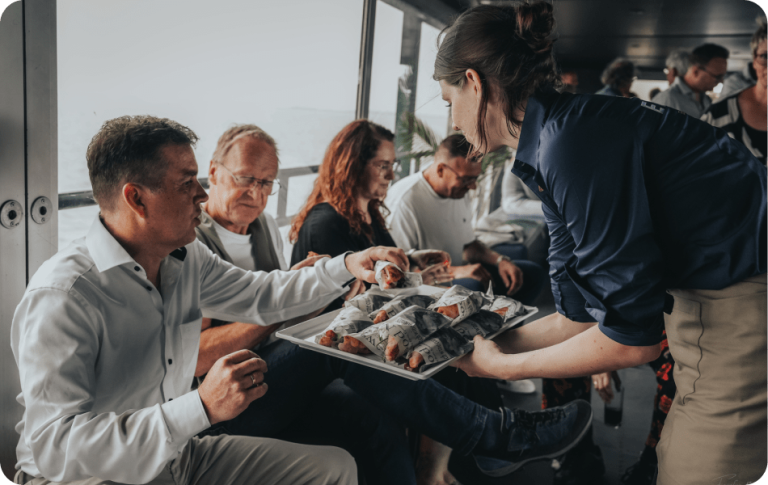
Get up, walk around, talk to an exhibitor, have a bite: that rhythm calls for food that you can eat with one hand. Walking bites in a small glass or on a toothpick work better than a plate that you can’t put anywhere.
- Choose snacks without sauce that can drip, especially when eating with a fork.
- Work with a fixed alcohol policy and communicate this in advance to exhibitors and visitors.
- Plan service runs in waves, adjusted to the volume of traffic at the opening and during breaks in the program.
- Fill the program with short pitches, a product demo or live music between the service runs.
- Adjust the lighting and sound level to suit the nature of the event: businesslike and quiet, or lively instead.
Well-thought-out bar setup prevents queues and keeps the flow of people at the bar just as smooth as it is at the stands.
Pro tip: Always serve a warm snack round lunchtime at a business-oriented mini fair. Visitors will therefore stay on board longer, which means more time at your exhibitors' stands.

What does a mini fair on a boat cost and what should you pay attention to?
The main cost items are location rental, catering, technology, and staff for setup and guidance. These costs vary significantly depending on the number of guests, the duration, and the desired level of service; therefore, always request a customized quote instead of relying on fixed amounts.
When you are making an offer, you explicitly check what exactly ‘all-inclusive’ covers. Is the technology for presentations included? Is the catering included in the price, or just the snacks? An early and clear budget prevents surprises later on, especially with standard cost items such as electricity, lighting and stand rental.
Please pay attention to these points in the contract:
- Cancellation terms and the period within which free cancellation is still possible.
- Liability for damage to the ship or to the stand equipment.
- The amount of any deposit and the conditions for its return.
- Hourly rates for overtime, for example when the program is running over time.
Some full-service providers cover location, catering, technology, and entertainment within a single quote, as can be seen at events like the Rotterdam Salsa Festival Boat Party.
How do you book a mini fair on a boat without hassle?
Booking directly works best if you have three things in mind in advance: the desired date with an alternative, the expected number of guests, and the desired level of service for catering and technology. With that basis, a full-service provider can create a concrete quote within a few days instead of endlessly emailing back and forth about individual components.
Always ask about availability on your desired date and for a second option as a backup when you first contact them. Ships with adequate capacity for small-scale fairs are often booked weeks to months in advance, especially in the autumn and around product or brand launches.
A few practical guidelines when booking:
- Always ask for a written confirmation of the date, capacity, and services included, not just an oral commitment.
- Make sure you know who is your main point of contact for the provider during the preparation process.
- Ask for a demonstration setup or previous footage from similar events, such as the Multinotes Showcase which took place during the Amsterdam Dance Event.
- Confirm the number of exhibitors and visitors as early as possible, so that the layout of the stands can be prepared in time.
Anyone who has already written down these four points for the first conversation will save themselves several rounds of offering offers back and forth.
How much time does it take to organize a mini fair on a boat?
For a small-scale fair on a ship, plan for several weeks from initial contact to implementation. This period allows for location confirmation, exhibitor recruitment, technical coordination, and communication with visitors.
The first two to three weeks are dedicated to location selection and quote comparison. After that comes the phase in which you approach and finalize exhibitors, which usually takes three to four weeks because companies themselves also need internal approval. In parallel, the technical preparations are underway: power plans, Wi-Fi tests and the stand layout are ideally finalized two to three weeks before the event, as also shown by step-by-step approaches for trade fair organization.
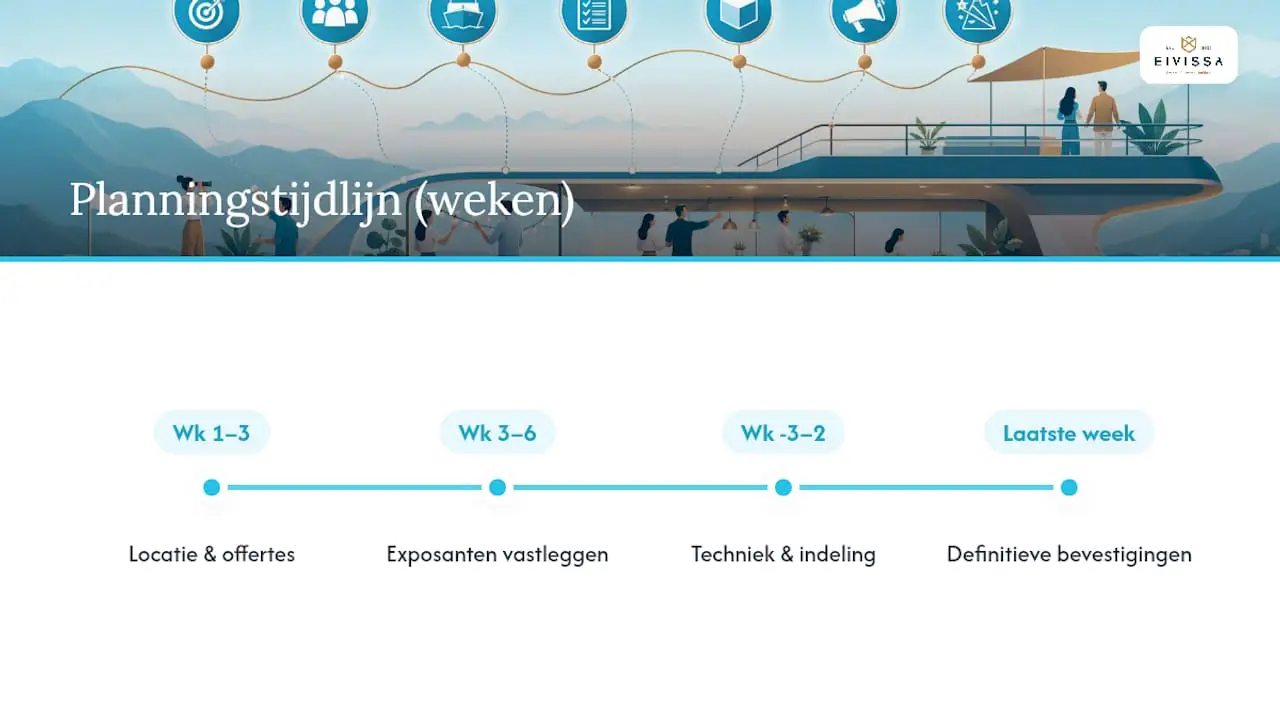
The final week before the event is dedicated to confirmations: final guest lists, catering numbers and a final check with the harbor master. With a full-service partner, much of this coordination time is eliminated, because location, technology and catering are already coordinated before you have to arrange them separately. That often shortens the lead time by several weeks compared to buying everything separately yourself.
When is a ship a smart choice? Considerations for decision-makers
A ship immediately sets you apart from the standard exhibition floor. The networking effect of sailing together on board, without an easy way out, creates conversations that do not occur in a regular venue. Visitors remember a boat exhibition years later, which rarely happens in a hall on the waterfront.
On the other hand, a ship is less flexible in terms of accessibility and capacity than a fixed venue, and the costs for technology and logistics are often higher. For events with fewer than a hundred guests or with a very limited budget, a conventional venue is often more logical. As scale, image, and guest experience become more important than pure cost minimization, outsourcing to a full-service partner is often preferred: the experience from events like the Rotterdam Salsa Festival Boat Party shows that a well-organized ship event runs smoothly without the organizer having to manage all the individual components themselves.
— Eivissa
Eivissa-events organizes your mini-fair from A to Z on a boat
Where most locations rent you an empty space and leave the rest to you, a full-service provider provides location, catering, technology, entertainment, and logistical support as a single unit, so you don’t have to coordinate ten suppliers yourself for one afternoon on the water.
The booking process consists of four steps: you request a quote with your desired date, number of guests and service level, you receive a customized proposal, you confirm the booking and together we prepare a plan of action for the day itself. The same approach was used for events such as business corporate party that was previously organized, where customers appreciated the smooth execution and the added effect of sailing.
Want to know if your mini fair fits in one of the available locations? Check out the options for a Event venue in Rotterdam or request an offer directly via the page Renting an event venue.
Sources
Frequently asked questions
Is a mini fair on a boat suitable for small budgets?
That depends on the number of guests and the desired level of service; with fewer than a hundred guests, a conventional location is often more cost-effective, while a ship pays off primarily at events where distinctive appeal and guest experience are important factors.
How many exhibitors can fit in a mini-fair on a boat?
That varies per ship and deck, but expect several dozen stands per deck with a compact stand layout of two by two meters, depending on floor space and mandatory escape routes.
Who regulates the permits for a fair on the water?
A full-service partner usually arranges port communications and permits as part of the package, which saves the organizer a lot of work.
How do you prevent a weak internet connection on board?
Always test Wi-Fi in advance on-site and work with a mobile hotspot as a backup, as public networks on floating locations appear to be less stable.
How far in advance should I book a ship for an exhibition?
Expect eight to twelve weeks from initial contact to execution, and book earlier if your event falls in the autumn or around a major launch, because suitable vessels are then more quickly booked out.